
Browse the Collection Record
Images
Metadata
Object Name |
The Lindisfarne Gospels |
Object ID# |
MC 0967 |
Artist (original) |
Scribe Eadfrith became Bishop of Lindisfarne in 698 |
Date |
700 AD |
Description |
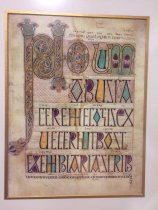
The Lindisfarne Gospels, a prized example of Celtic Illuminated Manuscript, contains the text of the four gospels in Latin as well as Jerome's preface to his translation, the Latin Vulgate. This image and elaborate initial letter, marks the beginning of Jerome's preface. More information is available alongside the full facsimile of the Lindisfarne Gospels on display to page through on the central round table of the exhibit By any standards an outstanding masterpiece of early mediaeval book painting, it is one of the few early gospel books to have survived complete, comprising 258 folios. The Lindisfarne Gospels was written and illuminated in the Northumbrian island monastery from which it takes its name at the end of the seventh century. A colophon added to the manuscript 250 years after its completion but generally accepted as reliable, tells us that it was written in honour of God and St. Cuthbert and gives the names of the four craftsmen involved. The scribe was Eadfrith, who became Bishop of Lindisfarne in 698, the binder was Aethilwald, and ornaments of gems and precious metals were applied to the binding by Billfrith the Anchorite. The fourth contributor was Aldred who added a translation into Old English between the lines of the original Latin text and also provided the colophon. Each of the four Gospels opens with a miniature depicting its evangelist, accompanied by his symbol, a decorative 'carpet' page (so called because of their intricate, woven patterns) and a major initial, followed by lines of decorated capitals. Modern study has shown the Eadfrith was responsible for both the text and decoration of the whole manuscript, apart from a very few minor details. The book must therefore have been completed before his death in 721. It seems most likely that it was in fact made to honour the elevation of St. Cuthbert's relics in March 698. The manuscript's history can be traced almost without interruption from its production to the present day. One of the proudest treasures of Durham Cathedral from the tenth century until the Reformation, it later belonged to Sir Robert Cotton, passing with his library into the newly founded British Library upon its foundation in 1973. |
Place of Origin |
Britain |
Medium |
Page |
Metzger Location |
Gallery |
Location of Original |
The British Library London. Cotton MS Nero D IV |
Dimensions Details |
Height: 300 mm Width: 230 mm |