
Browse the Collection Record
Images
Metadata
Object Name |
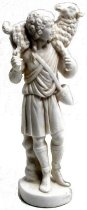
The Good Shepherd |
Object ID# |
MC 0411 |
Description |
This statuette from the catacomb of Domitilla is one of the few early Christian examples of a free-standing sculpture. The Good Shepherd is frequently depicted in early Christian art, with clear reference to Psalm 23 and John 10:11-18 One of the few early Christian examples of free-standing sculpture. Since no description of Christ's physical appearance exists, Christian artists drew on non-Christian traditions from various areas. Christ was first shown in the role of the Good Shepherd (c.200), and depicted as a short-haired, unbearded youth modelled after classical portrayals of Hermes and Apollo. Somewhat later, in Asia Minor, long, flowing hair down to the shoulders was added; in the late fourth century Asian and Italian artists began to add a beard, which completed the portrait of Christ as accepted in later Christian art. The representation of a shepherd with a calf, sheep or ram on his shoulders had been used in the Mediterranean area since the 7th century BC. Previously, it was the believer who brought his sacrificial animal to the altar. Here it is the shepherd and lamb together: the Good Shepherd of Luke 15:4-5 (the lost sheep) and of John 10:10-18 "I am the good shepherd..." From the catacomb of Domitilla |
Place of Origin |
Rome |
Medium |
Statuette |
Material |
Marble (orig.) |
Metzger Location |
Christian History |
Location of Original |
The Lateran Museum Rome |
Dimensions Details |
Height: 217 mm Width: 88 mm Depth: 61 mm |