
Browse the Collection Record
Images
Metadata
Object Name |
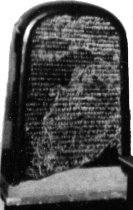
The Moabite Stele (Moabite Stone) |
Object ID# |
MC 0595 |
Date |
c.850 BC |
Description |
The Mesha stele was erected by the Moabite king, Mesha, to commemorate his accomplishments as king - especially his military victories. Mesha attributed his success to the chief Moabite god, Chemosh, and placed the stone in the sanctuary he constructed for Chemosh. Using the first person, Mesha extols himself for liberating Moab from the oppressive rule of the dynasty of Omri, King of Israel, of defeating Moab's enemies, expanding Moab's territory, and for the various building projects he undertook. In one of the military victories referenced, Mesha battles with Joram (also Jehoram, grandson of Omri), King of Israel, and Jehoshaphat, King of Judah. This event is also included in 2 Kings 3, though exact details differ as one might expect with two accounts told from different sides of the battle. In addition to the specific mention of Omri and his "son," the stele makes the earliest known reference to the name of Israel's God, Yahweh ("I took from [Nebo] the vessels of Yahweh and dragged them before Chemosh"), and also possibly makes reference to David (in a difficult to translate phrase, "the altar-hearth of David"). The language of the inscription is Moabite, a dialect very close to Biblical Hebrew. It was incised on a basalt stele and seems originally to have contained thirty-six lines. The stele was discovered intact at Dhiban, (ancient Moabite capital, Dibon), in 1868 by a German missionary. The local Bedouin, thinking that the stone contained hidden treasure or possessed magical properties, broke it up into many fragments. Fortunately a "squeeze" copy had been made prior to this vandalism. Based on that squeeze, the recovered fragments have been pieced together and are now on display at the Louvre. |
Place of Origin |
Diban Transjordan |
Medium |
Stone pillar |
Material |
Basalt (orig,) // Plaster (copy) |
Location of Original |
The Louvre Paris |
Credit line |
Courtesy of Vancouver School of Theology |
Dimensions Details |
Height: 124 cm Width: 71 cm |