
Browse the Collection Record
Images
Metadata
Object Name |
Back of a Mirror |
Object ID# |
MC 0819 |
Date |
Early 14th Century |
Description |
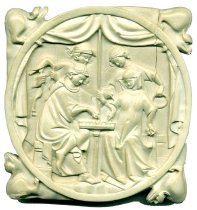
The back of a mirror, depicting a game of chess, illustrates the quintessence of the French court around AD 1300. The image's composition highlights the chessboard and the three sets of hands. The design for this reproduction of an ivory mirror case dates to a time in which chivalry and refinement of manner held a fascination for Europeans. This interest was reflected in the decoration of the home. Everyday items were richly adorned with scenes of jousting, of courtly love, or perhaps, as here, of a chess game. This particular example has been recarved from photographs. The scene is situated under a pavilion whose curtains are opened to show us the young man sitting, legs crossed (a symbol of ability), holding in one hand the post which supports the house, and taking part in the game of chess in the other hand; opposite him, the young woman who wears under her veil the horned hairstyle as decreed by her preacher, controls a part of a finger and holds two parts in her other hand, to perhaps cheat; behind her, the maidservant, who holds a crown ready, suggests a strategy. Behind the young man, a servant holds his fist away. Four dragons, confirming the part, the work is looked after: finely characterized faces, eyes wide open and the drapery very flexible. The theme of the game of chess is seen often enough on the backs of mirrors, though this specimen with its four characters is rare. It is possible that this representation refers to a scene from Huron of Bordeaux's novel of Tristan and Yseult, if one compares it with an email of the treasure of Louis d'Anjou, written in 1379-1380 where Tristand and Yseult play chess under a pavilion. Or else, it can simply be a question of representing a common aristocratic past-time, being the ivory-craftsman's best customers. By opposing the set of symbols of disorderly and corrupt love, rather, it indeed evokes courtly love, held up by precise rules, as the crown indicates, held by the maidservant (a sign of the crowning of the Lover), it is by no means a symbol of platonic love. |
Place of Origin |
France |
Medium |
Carving |
Material |
Ivory (orig.) |
Metzger Location |
Christian History |
Location of Original |
The Louvre Paris |
Dimensions Details |
Height: 120 mm Weight: 115 mm |